
How do betting odds work? One number, two readings
Test passport
- Checked
- 14 Oct 2026 (iPhone, Nigerian IP), after checks on 8 and 13 Oct
- Device
- Phones only: Android Chrome (8 and 13 Oct), iPhone Safari (13 and 14 Oct)
- What we did
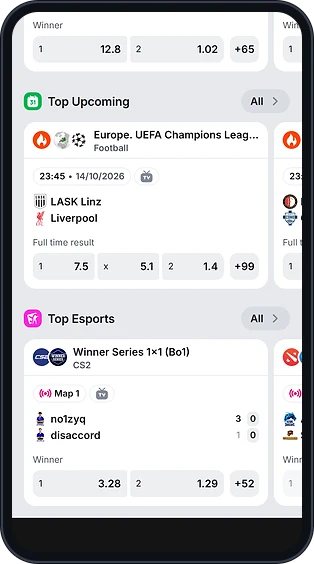
- Read 1X2 prices on ten top matches on 14 Oct, including Man City v PSG and LASK v Liverpool
- What we did not do
- No app installed; no deposit, withdrawal, document upload or bet made
What is odds, in desk terms? A decimal price is the full amount returned for each ₦1 staked if the bet wins, with the stake inside it. So the first reading is money: stake × price = return, and return − stake = profit.
Worked example
Here is a worked example with a price our check saw on 13.10: Sporting CP away at Lens, 2.61.
Worked example · illustration, not a tip
- Stake
- ₦2,500 on Sporting CP
- Odds
- 2.61
- Result
- Sporting CP win
- Return
- ₦2,500 × 2.61 = ₦6,525, so the profit is ₦4,025
The second reading is a chance. Divide 1 by the price: 1 ÷ 2.61 = 38.31%. That is the odds meaning in one line: the price is what the bookmaker pays, given the chance it builds the price on. The meaning of odds in betting is never “this will happen”; at 2.61 the price itself expects Sporting to fall short about six times in ten.
The margin desk: four markets from our checks
Add the implied chances of every outcome in a market and a fair book would total exactly 100%. Real sports betting odds total more. The surplus is the margin, also called the overround. It describes how the price is built; it is not a forecast of what one bettor will lose.
| Match, 1X2 prices seen | Book total and margin (our sum) |
|---|---|
| Man City v PSG, 14.10: 2.09 / 4.03 / 3.21 | 103.81%, margin 3.81% |
| LASK v Liverpool, 14.10: 7.5 / 5.1 / 1.4 | 104.37%, margin 4.37% |
| Lens v Sporting CP, 13.10: 2.54 / 3.75 / 2.61 | 104.35%, margin 4.35% |
| Arsenal v Lille, 13.10: 1.21 / 6.6 / 14.0 | 104.94%, margin 4.94% |
| Ten top matches, 14.10 (tester’s notes) | Average about 4.5%, range 3.7–5.0% |
Lens v Sporting, line by line
- Lens: 1 ÷ 2.54 = 39.37%
- Draw: 1 ÷ 3.75 = 26.67%
- Sporting CP: 1 ÷ 2.61 = 38.31%
- Total: 39.37 + 26.67 + 38.31 = 104.35%, so the margin is 4.35%
The same three steps give every row of the table. Do them once yourself and the sheet stops being something you trust and becomes something you can repeat.
Why two rows differ from the tester’s notes
The tester’s notes for 14.10 give 3.93% for Man City v PSG and 4.55% for LASK v Liverpool. Recomputed from the prices on record, they come to 3.81% and 4.37%. Prices move during the day, so one possible reason is that the notes and the listed prices were taken a few minutes apart; we cannot confirm it. We print our own sums because they follow from numbers you can see; on either count, these two matches sat between roughly 3.8% and 4.6%.
Taking the margin out: the fair price
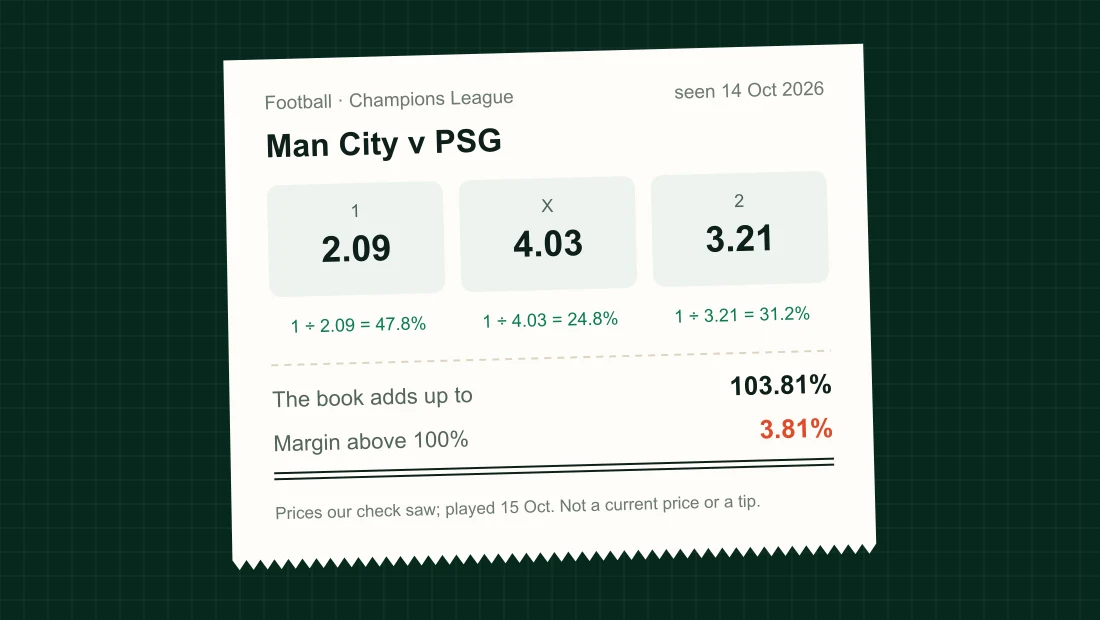
A fair price is the price with the bookmaker’s share removed. The simplest method spreads the margin in proportion: multiply each price by the book total.
For LASK v Liverpool the book total is 1.0437:
- LASK: 7.5 × 1.0437 = 7.83
- Draw: 5.1 × 1.0437 = 5.32
- Liverpool: 1.4 × 1.0437 = 1.46
Check the work: 1 ÷ 7.83 + 1 ÷ 5.32 + 1 ÷ 1.46 comes back to about 100%. On a ₦10,000 single on Liverpool the board returns ₦14,000; the fair price would return about ₦14,612. The ₦612 gap is the margin on that one bet.
This is still the bookmaker’s view of the chances, only cleaned. Other methods load more of the margin onto outsiders, so treat a fair price as a reference point for your own judgment, not a prediction.
High odds, low odds and the "most winning" band
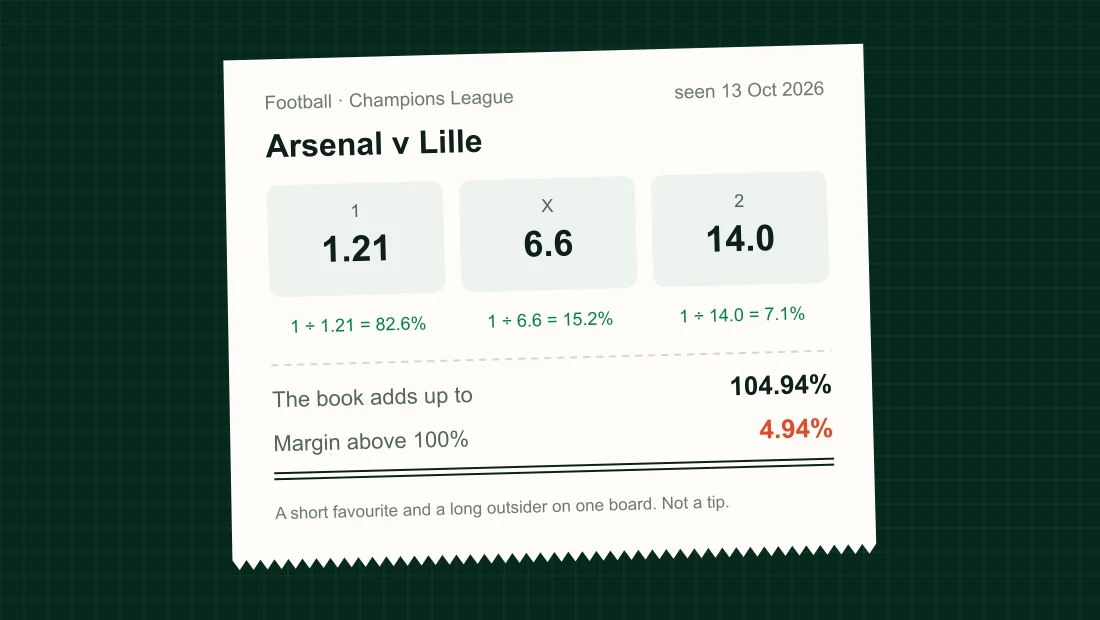
High odds pay a lot because the price expects them to lose most of the time. Arsenal v Lille shows both ends on one card.
Worked example
₦3,000 on Arsenal at 1.21 returns ₦3,630, a profit of ₦630; the price implies 82.64%. ₦3,000 on Lille at 14.0 returns ₦42,000; the price implies 7.14%. Neither is better value by itself. The margin sits inside both, and that match carried the highest margin of our four, 4.94%.
People search for the most winning odds in football as if one band of prices were both safe and rewarding. No such band exists: short prices win more often on the price’s own view and pay little, long prices pay more and lose more often. Football odds, or soccer odds as they are called abroad, follow the same arithmetic as tennis or basketball prices.
Fixed odds and moving odds

Odds in betting are fixed at the moment your bet is accepted. If a price drifts from 2.61 to 2.80 after you stake, your bet still settles at 2.61; if it shortens, you keep the longer price.
Before kick-off, prices move with team news and money; in play they move with every goal and minute. At the time of the 14.10 check the live board had about 185 events. The sports rules also say that a price posted with an obvious error in team, player, date or time can be voided, so a “too good” number is not locked in.
Reading sports betting odds on the 1win.ng slip
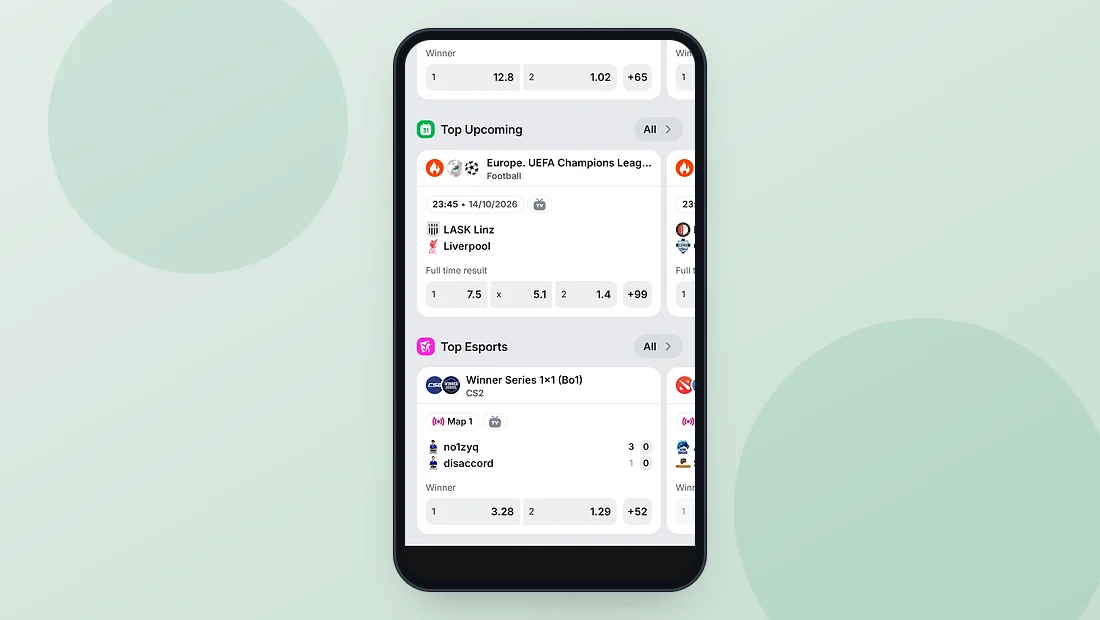
The tester saw decimal prices only and no switch to another format; the profile settings, where a switch might sit, were not opened. Once a price is tapped, the slip shows a “MAX Possible win” line, which is the return, stake included.
One big match carries far more than a 1X2: the Man City v PSG page had about 87 markets, among them Asian handicaps in quarter lines and Asian totals. Our page of slip steps exactly as the 14.10 check saw them shows where the stake goes, and the glossary with the overround, value and other terms explained covers the vocabulary. For markets beyond the 1X2 line, see football markets past the match result.
Other formats in one line each
- Fractional shows profit over stake: 2.61 decimal is 1.61/1, close to 8/5.
- American uses 100 as its base: 2.61 is +161, and 1.21 is −476, meaning ₦476 staked to win ₦100.
Pros
- Decimal prices that can be summed by hand
- Margins below 5% on all four markets we recomputed
- Deep market lists on big matches, including Asian quarter lines
- A slip line that shows the full return before you stake
Cons
- No odds-format switch seen
- Lower-division margins not measured
- Two of our sums differ from the tester’s notes, so any single figure is a snapshot
Odds and margins: our score
7.5/10
Desk score · 1win.ng checked 8, 13 & 14 Oct 2026 · how we score
Odds and margins is our highest area. The prices are clear, and the four 1X2 markets we recomputed carried margins of under 5%; marks are lost for one format only and for a sample limited to top matches.
It suits bettors who like to turn a price into a percentage before staking and who follow major European football, where our sums were done.
Who should skip it: anyone who wants fractional prices on screen, and bettors who stay with lower leagues, where we have no margin figures.
Open 1win.ng18+ · T&C Apply · operator named in the 1win.ng footer: BID Entertainment Limited
What changed on this page
- Page written for 1winsbet.net.ng from our checks of 1win.ng on 8, 13 and 14 October; every 1win figure is marked by source.
Found a mistake? Write to [email protected] and we will date the fix here.
FAQ
How do I turn odds into a percentage?
Divide 1 by the decimal price. Odds of 2.61 imply 1 ÷ 2.61 = 38.31%.
What is the bookmaker's margin?
The amount by which a market's implied chances exceed 100%. Lens v Sporting on 13.10 totalled 104.35%, a margin of 4.35%.
Is the return the same as the profit?
No. The return includes your stake; the profit is the return minus the stake. ₦2,500 at 2.61 returns ₦6,525, of which ₦4,025 is profit.
Do high odds mean a better bet?
No. High odds pay more because the price rates the outcome as unlikely, and the margin is built into long and short prices alike.
Can my odds change after the bet is placed?
The board can move, but an accepted bet keeps its price. A price with an obvious error can be voided under the sports rules.
What odds format does 1win.ng use?
Decimal. No switch to another format was seen on 14.10, though the profile settings were not opened.